Showing posts with label storms. Show all posts

Thursday, November 7, 2013

Super Typhoon Haiyan

Aloha! It has sure been busy at the lab this year, but something like Haiyan doesn't happen every day, so here I am! I have just a quick post today with a few figures and a new track. Enjoy!

The CTBTO IMS station I39PW is located on the island of Babeldaob in Palau. Super Typhoon Haiyan ran over the northern most state of Palau, Kayangel island on 06 November 2013 UTC. The infrasound station I39PW recorded the approach, and part of the typhoon before losing power late in the day UTC.

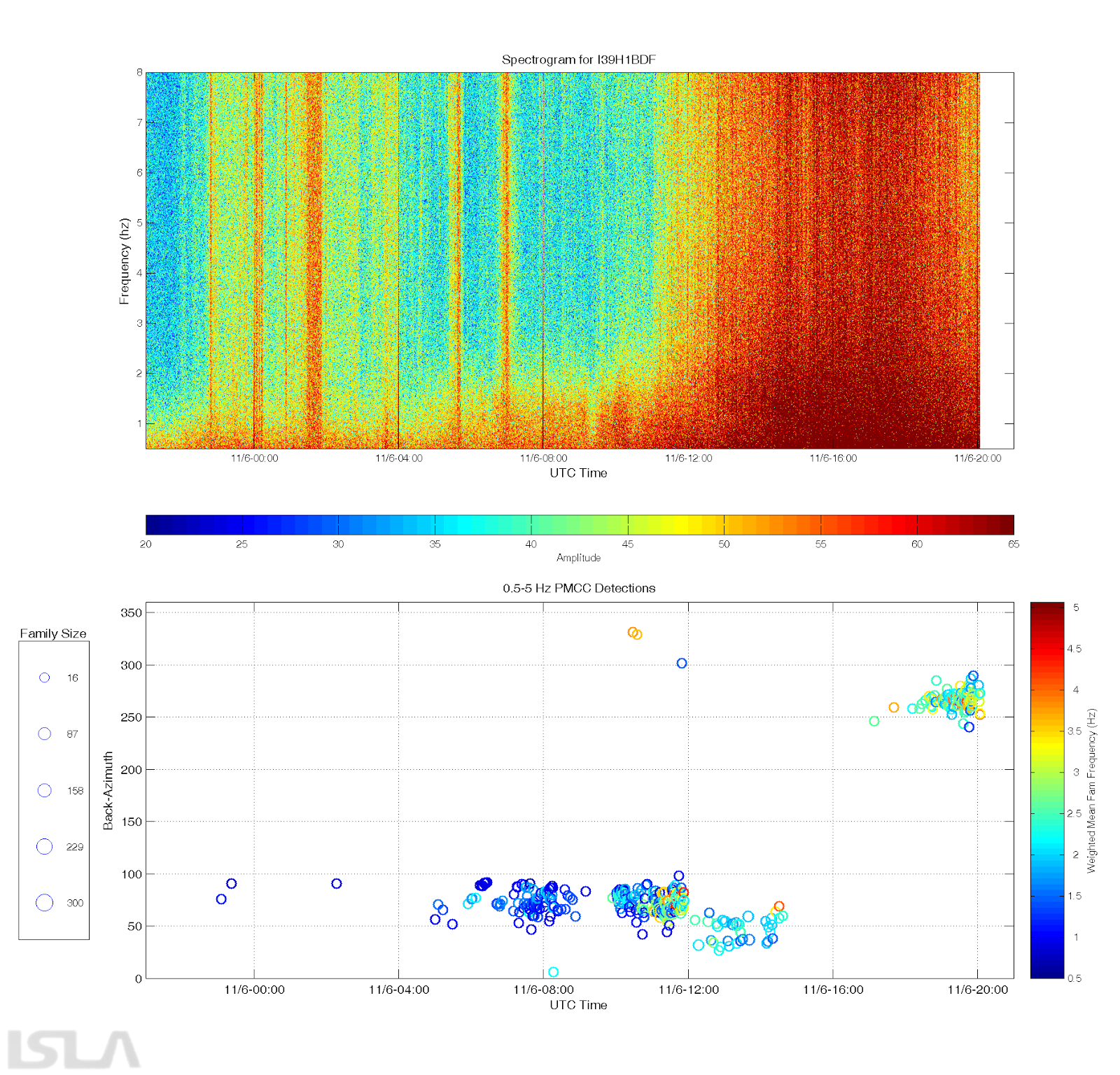
Spectrogram and array processing results from I39PW created by ISLA.

I recommend also listening to the infrasound data sped up ~ 2000x so it is in the audio range while viewing the figures. The following track is around 10 hrs of data covering the ramp up of the storm as well as the storm passing over, up until the station lost power.


Super Typhoon Haiyan was a category 5 when it slammed into Palau. According to an article on gizmodo the storm has broken the intensity scale by 0.1 when it registered 8.1 out of 8. It is beautiful and dangerous. The lab's thoughts are with the people of the Philippines.

Aqua/MODIS 11/07/2013 04:25 UTC

You can read more:

Friday, December 14, 2012

Super Typhoon Bopha

Over the coming weeks and months, we will be sharing data products from our Super Typhoon Bopha data set. Bopha began as a tropical storm east of our array in Palau, and intensified as it narrowly missed Palau on its way to the Philippines. ISLA staff were recently in Palau to upgrade an IMS infrasound station (International Monitoring System). The last of the field crew, (including yours truly) completed the work and left just 2 days before the arrival of Typhoon Bopha. We will be presenting products from this exciting data set recorded with our newly upgraded system.

More information on the array

This is the first of our data products. This audio file is 24 hrs of data from 00:00:00 UTC on December 2, 2012. It has been sped up by a factor of 2200 resulting in a ~39 second clip.


From 0-10 seconds you can hear the typhoon approach the island
Around 12 seconds, signal from the high period surf becomes noticeable
Around 30 seconds, signal from long period surf becomes noticeable

We recommend playing this track several times, and using different EQ settings. We have been having fun playing it on different systems with different frequency responses.

For those interested in waveforms, this signal has been band-pass filtered from 40Hz to 6kHz after being sped up by a factor of 2200. This maps the 0.2 Hz microbarom (ocean storm) peak to 440Hz (a concert A).